Transportation Accident Claims
Buses, trains, rideshares, and other common carriers owe their passengers a heightened duty of care under California law. When that duty is breached and passengers are injured, the responsible parties — including government entities — must be held accountable.
Personal Injury
California Transportation Accident Law
Transportation accidents involving buses, trains, rideshare vehicles, and other common carriers present unique legal challenges. Under California Civil Code sections 2100–2101, common carriers owe their passengers the highest degree of care—a standard significantly more demanding than the ordinary negligence standard that applies to typical motor vehicle accidents. At The Law Offices of Farris Ain, we understand the complex liability frameworks that govern these cases and fight to hold all responsible parties accountable.
Common Carrier Liability in California
California Civil Code section 2100 establishes that a common carrier—any entity that transports passengers for hire—must use the utmost care and diligence for the safe carriage of its passengers. Section 2101 further requires carriers to do everything reasonably necessary to protect passengers, including providing a safe vehicle, safe environment for boarding and exiting, and protection from the misconduct of other passengers.
This heightened standard of care means that conduct which might not constitute negligence in an ordinary car accident case can be actionable when committed by a common carrier. Even a momentary lapse in attention by a bus driver, for example, may be sufficient to establish liability under this elevated standard.
Bus Accidents
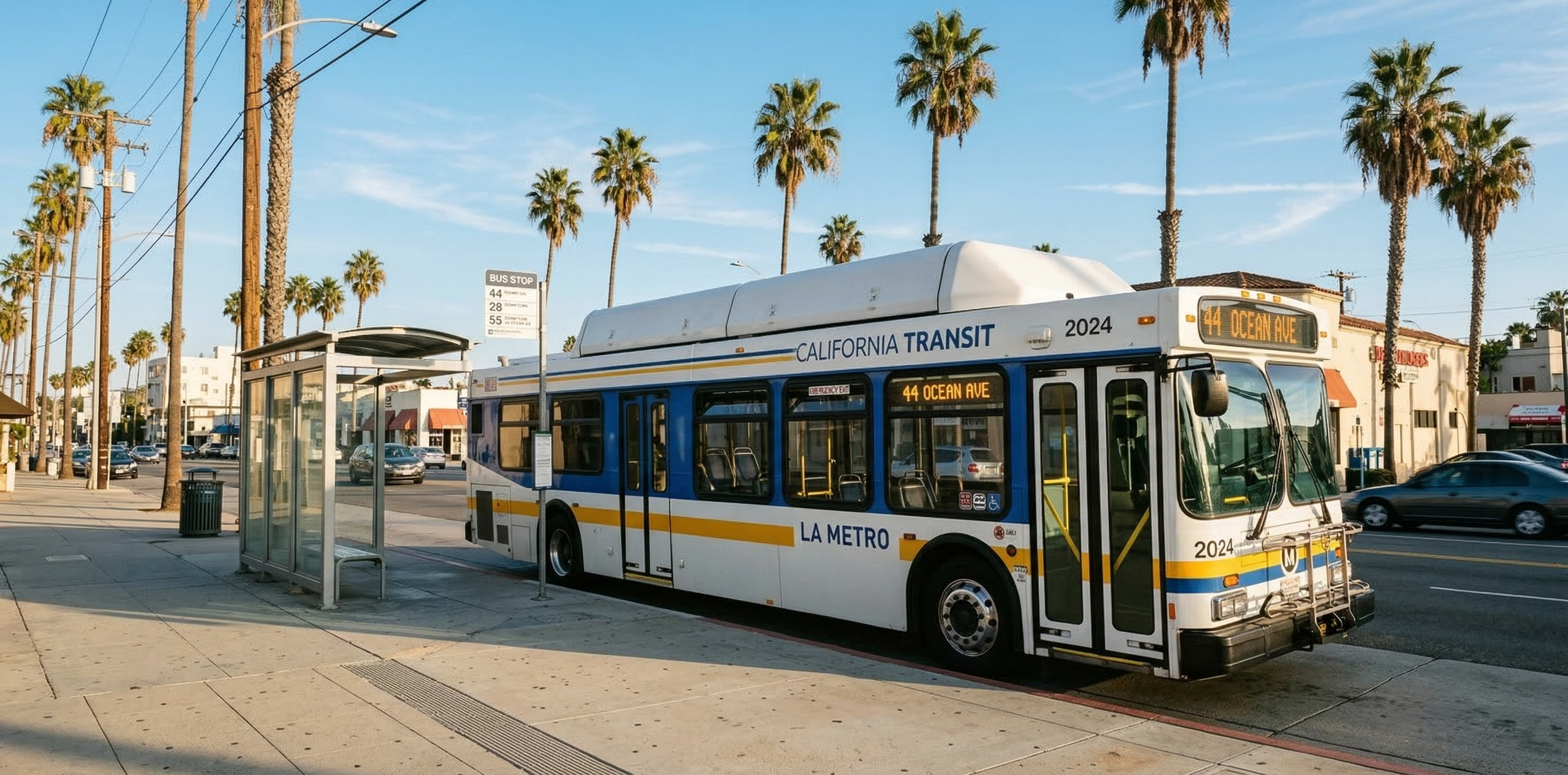
Public Transit Buses
Accidents involving public transit buses operated by agencies such as Metro, Foothill Transit, or Omnitrans present the additional complexity of government entity liability. Under the California Government Claims Act (Government Code sections 810–996.6), a victim must file a formal government tort claim within six months of the date of injury—a dramatically shorter deadline than the standard two-year statute of limitations.
Common causes of public transit bus accidents include driver fatigue from long shifts, inadequate driver training, failure to properly secure passengers before moving, sudden stops and starts, and deferred maintenance on aging bus fleets.
School Buses
School bus accidents involving children require particular sensitivity and urgency. School districts and their contracted bus operators owe students an extraordinary duty of care. These cases often involve injuries to children boarding or exiting buses, collisions caused by driver negligence, and failures to properly maintain safety equipment including stop arms and warning lights.
Charter and Tour Buses
Charter and tour bus companies are regulated as common carriers and are subject to both federal and state safety standards. Rollover accidents, which are disturbingly common with charter buses, often result in mass casualty events with multiple victims suffering catastrophic injuries. These cases frequently involve negligent hiring, inadequate driver training, and failure to comply with hours of service regulations.
Train and Rail Accidents
Train accidents—whether involving commuter rail (Metrolink), light rail, subway systems, or freight trains—can cause devastating injuries due to the massive size and speed of rail vehicles. Common causes include signal failures, grade crossing defects, inadequate platform safety, operator error, and track maintenance failures. Rail accident cases often involve multiple government entities and private contractors, requiring careful identification of all potentially liable parties.
Rideshare Accidents: Uber and Lyft
Rideshare accidents involving Uber, Lyft, and similar platforms create complex insurance coverage issues. These companies maintain layered insurance policies that vary depending on the driver’s status at the time of the accident:
- App off: Only the driver’s personal auto insurance applies
- App on, waiting for a ride request (Period 1): Limited contingent liability coverage from the rideshare company (typically $50,000 per person / $100,000 per accident for bodily injury)
- En route to pick up or during a trip (Periods 2–3): The rideshare company’s full commercial policy applies ($1,000,000 in third-party liability coverage)
Important 2026 change: Effective January 1, 2026, California’s Senate Bill 371 significantly reduced the uninsured/underinsured motorist (UM/UIM) coverage that rideshare companies must carry during active trips—from $1,000,000 down to just $60,000 per person / $300,000 per accident. This means that if you are injured by an uninsured or underinsured driver while riding in an Uber or Lyft, the available UM/UIM coverage is now dramatically lower than before. While the $1,000,000 third-party liability coverage for at-fault accidents remains, the reduced UM/UIM protection makes it even more important to have experienced legal counsel evaluate all available coverage.
Navigating these insurance layers—and determining which policy applies at the precise moment of the accident—requires experienced legal counsel. Rideshare companies aggressively dispute coverage and attempt to shift liability to the individual driver whenever possible.
Aviation Incidents
While less common, aviation incidents involving commercial airlines, regional carriers, charter flights, and helicopters can result in catastrophic injuries and complex liability determinations. These cases may involve federal aviation regulations (FAA), airline negligence, aircraft manufacturer defects, maintenance facility errors, and air traffic control failures. Aviation cases often require specialized expert witnesses and an understanding of federal preemption issues.
Government Entity Claims
When a transportation accident involves a government-operated vehicle or facility—public transit buses, commuter rail, or dangerous road conditions maintained by a government entity—the California Government Claims Act imposes strict procedural requirements:
- A formal government tort claim must be filed within 6 months of the date of injury (Government Code § 911.2)
- The claim must be filed with the correct government entity (city, county, state agency, or special district)
- The claim must include specific information: date, location, circumstances, injuries, and a stated dollar amount
- Failure to file a timely claim generally bars the lawsuit entirely, regardless of the merits
This six-month deadline is one of the most critical aspects of any government transportation accident case. Missing it can permanently destroy an otherwise meritorious claim.
Multiple Liable Parties
Transportation accident cases frequently involve multiple defendants, including the vehicle operator, the operating company or government agency, vehicle and parts manufacturers, maintenance contractors, road designers and construction companies, and other negligent drivers. Identifying and pursuing all responsible parties is essential to maximizing recovery, particularly in cases involving catastrophic injuries.
“Common carriers owe their passengers the highest duty of care under California law. When they fail that duty, we hold them to the standard the law demands.”
Injured in a Transportation Accident?
Common carriers owe you the highest duty of care. If you were injured on a bus, train, or rideshare, contact us for a free consultation before critical deadlines pass.