Slip and fall accidents are one of the leading causes of emergency room visits in the United States, and many of them happen because a property owner failed to maintain safe conditions. If you've been injured in a slip and fall on someone else's property in California, the law may entitle you to compensation, but proving your case requires more than simply showing that you fell. You need to establish that the property owner knew or should have known about the hazard and failed to address it.
California premises liability law holds property owners and occupiers to a duty of reasonable care. Understanding how that duty works, and how courts evaluate whether it was breached, is key to building a strong claim.
The Duty of Care in California Premises Liability Cases
Under California Civil Code Section 1714, everyone is responsible for injuries caused by their failure to exercise ordinary care. For property owners and occupiers, this means they must keep their premises in a reasonably safe condition and warn visitors of any dangerous conditions they know about or should know about.
Unlike some states that vary the duty of care based on whether the injured person was an invitee, licensee, or trespasser, California largely abandoned those rigid categories in the landmark case Rowland v. Christian (1968). The standard is simple: property owners owe a general duty of ordinary care to anyone on their property. The question is always whether the owner acted reasonably under the circumstances.
That said, the nature of the visitor's presence still matters as one factor among many. A grocery store that invites the public inside has a heightened practical obligation to inspect for hazards compared to a homeowner hosting a casual dinner party. Not because the legal standard is different, but because what counts as "reasonable" care differs with the context.
Actual Notice vs. Constructive Notice
The central battleground in most slip and fall cases is notice. To hold a property owner liable, you generally must show that they had actual notice or constructive notice of the dangerous condition.
Actual notice means the owner knew about the hazard. Perhaps an employee spilled something and didn't clean it up, or a customer reported a wet floor and the staff ignored it. Actual notice is powerful evidence but can be difficult to prove without witness testimony or surveillance footage.
Constructive notice is more common in slip and fall cases. It means the hazard existed long enough that a reasonably attentive property owner should have discovered and corrected it. This is where the facts get critical. How long was the spill on the floor? Was it a fresh puddle or had it been there for hours with visible foot traffic through it? Were there any inspection protocols in place, and were they followed?
The Ortega Decision: A Landmark for California Plaintiffs
In Ortega v. Kmart Corp. (2001), the California Supreme Court addressed constructive notice in a way that significantly benefits slip and fall victims. The court held that a property owner's failure to inspect the premises within a reasonable time period can, by itself, be enough to establish constructive notice of a hazard.
This is a point that many people, and even some attorneys, don't fully appreciate. You don't necessarily have to prove exactly how long a spill sat on the floor. If the store had no reasonable inspection system in place, or if the system it had wasn't being followed, that failure alone can support a finding that the owner should have known about the danger. The court applies a "totality of the circumstances" test rather than demanding that plaintiffs pinpoint the exact time the hazard was created.
A grocery store can't escape liability just because no employee happened to "see" the spill. If the store wasn't conducting regular walkthroughs, or can't produce records showing that it was, the jury can infer constructive notice.
Common Slip and Fall Hazards
Dangerous conditions that lead to slip and fall injuries take many forms. Some of the most common hazards we see in California premises liability cases include:
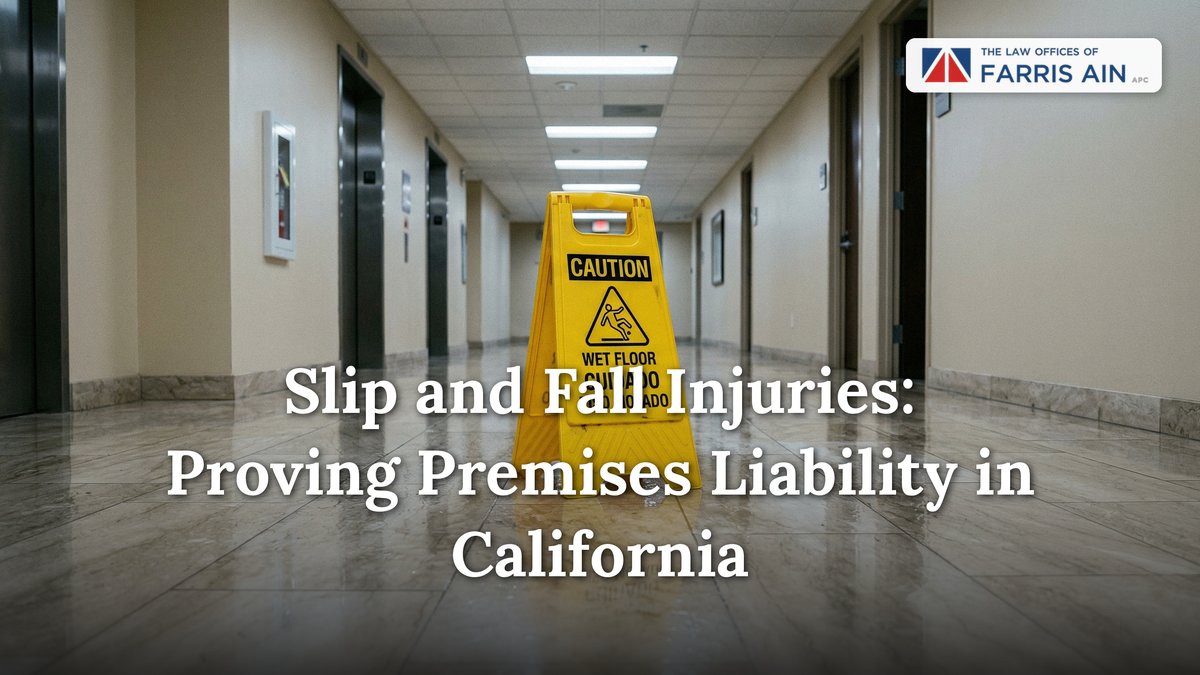
- Wet or slippery floors from spills in grocery stores, freshly mopped surfaces without warning signs, leaking refrigeration units, or rain tracked in from outside without mats
- Uneven surfaces like cracked sidewalks, broken tiles, raised carpet edges, and transitions between flooring types without adequate thresholds
- Poor lighting in stairwells, parking lots with burned-out lights, and dimly lit walkways or corridors
- Parking lot defects including potholes, crumbling curbs, inadequate drainage, missing wheel stops, and poorly marked pedestrian paths
- Missing or loose handrails on stairways, inconsistent step heights, worn treads, and low-visibility stairs
- Cluttered walkways with merchandise displayed in aisles, cords across pathways, or debris left in common areas
Commercial vs. Residential Premises Liability
While the legal duty of care applies to both commercial and residential property owners, the practical expectations differ significantly.
Commercial property owners (retailers, restaurants, hotels, shopping centers, office buildings) invite the public onto their premises for business purposes. Courts expect these owners to have systematic inspection and maintenance programs. A large retailer should have documented protocols for floor inspections, spill response, and hazard reporting. The absence of such protocols is itself evidence of negligence.
Residential property owners have duties as well, particularly landlords. Under California law, landlords must maintain common areas in a safe condition and repair dangerous conditions they know about or should discover through reasonable inspection. Homeowners can also be liable if they know about a hazard on their property (a broken front step, an icy walkway, a loose deck board) and a visitor is injured as a result.
The Role of Comparative Fault
California follows a pure comparative negligence system, which means that even if you were partially at fault for your fall, you can still recover damages. Your award will be reduced by your percentage of fault. For example, if a jury determines you suffered $200,000 in damages but were 20% at fault for not watching where you were going, your recovery would be $160,000.
Property owners and their insurers frequently argue comparative fault in slip and fall cases. Common defenses include claims that the hazard was "open and obvious," that the injured person was distracted by their phone, that they were wearing inappropriate footwear, or that they ignored warning signs. An experienced attorney knows how to counter these arguments and show that the property owner's negligence was the primary cause of the injury.
Documenting a Slip and Fall: Evidence That Wins Cases
The evidence you gather immediately after a fall can make or break your case. If you're physically able, take these steps:
- Photograph everything. Take pictures of the exact spot where you fell, the hazard that caused the fall (spill, crack, broken surface), your injuries, your footwear, and the surrounding area. Wide shots and close-ups both matter.
- Report the incident. Notify the property owner or manager and ask for a written incident report. Get a copy if possible.
- Identify witnesses. Get names and phone numbers of anyone who saw you fall or saw the hazardous condition.
- Preserve your clothing and shoes. Don't wash or discard the clothes and shoes you were wearing. They may be relevant evidence.
- Seek medical attention promptly. Even if your injuries seem minor at first, see a doctor as soon as possible. Some serious injuries, particularly head injuries and soft tissue damage, don't show symptoms right away. Medical records that connect your injuries to the fall are foundational to your claim.
- Request surveillance footage. Many commercial properties have security cameras. This footage is often deleted on a short cycle (sometimes within 24-48 hours), so requesting preservation immediately is critical.
Time Limits for Filing a Claim
California's statute of limitations for personal injury claims is generally two years from the date of the injury. If the property owner is a government entity (a city, county, or state agency), you must file an administrative claim within six months under the California Government Claims Act. Missing this deadline can permanently bar your claim, regardless of how strong it is.
This compressed timeline for government claims catches many people off guard. If you slipped on a broken sidewalk maintained by the city, fell on a wet floor in a public building, or tripped over a defect in a public park, the six-month clock is ticking from the day of your accident.
How Damages Are Calculated in Slip and Fall Cases
Successful premises liability claims can recover compensation for both economic and non-economic losses. Economic damages include medical expenses (past and future), lost wages, reduced earning capacity, and out-of-pocket costs related to your injury. Non-economic damages cover pain and suffering, emotional distress, loss of enjoyment of life, and similar intangible harms.
Slip and fall injuries are often more serious than people expect. Falls are a leading cause of traumatic brain injuries, hip fractures in older adults, spinal cord damage, and chronic back and knee injuries. The long-term medical costs and impact on quality of life can be substantial.
Talk to a California Premises Liability Attorney
If you've been injured in a slip and fall on someone else's property, don't assume the property owner's insurance company will treat you fairly. Their goal is to pay as little as possible, and they'll look for every opportunity to blame you or minimize the severity of the hazard. At The Law Offices of Farris Ain, we investigate premises liability claims throughout Southern California, gather the evidence needed to establish notice, and fight to hold negligent property owners accountable.
Contact us for a free consultation to discuss your slip and fall case. Call (888) 525-5989. There's no obligation and no fee unless we recover compensation for you.

The Law Offices of Farris Ain, APC
Attorney at The Law Offices of Farris Ain, APC. Dedicated to fighting for the rights of employees, consumers, and injury victims throughout Southern California.
Learn more about The Law Offices of Farris Ain, APC