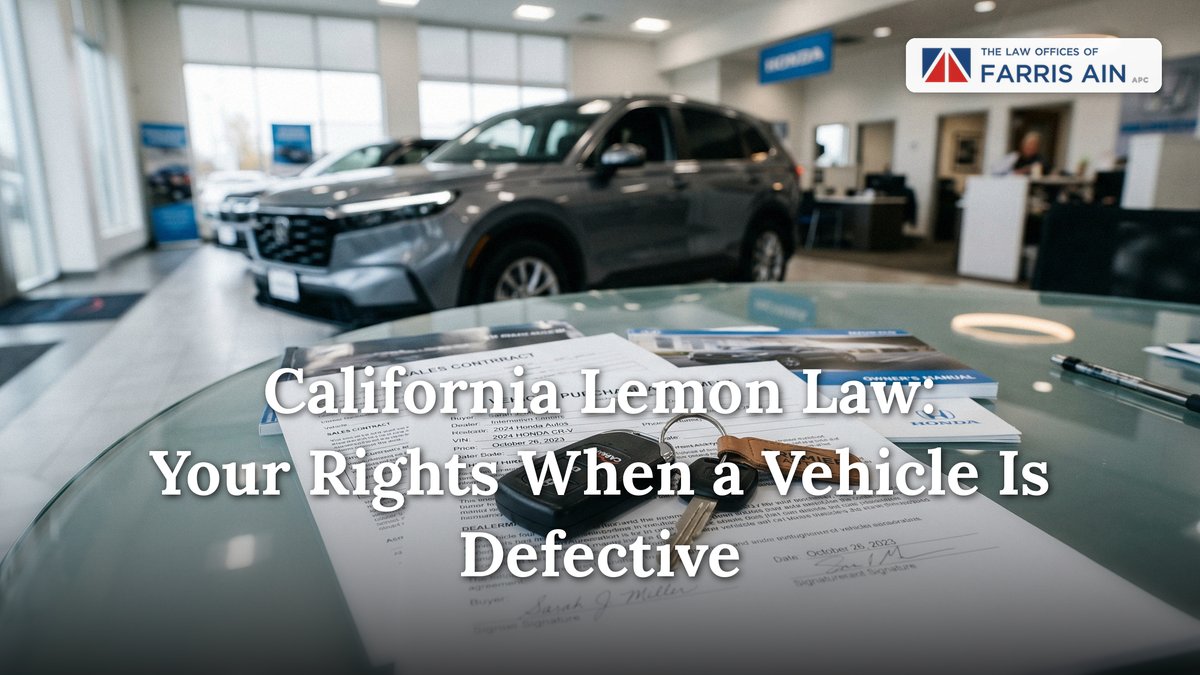
You bought a new car expecting reliability, only to find yourself back at the dealership again and again for the same unresolved problem. Or maybe you purchased a used vehicle with a warranty, and the dealer keeps telling you the issue is "fixed" when it clearly isn't. If this sounds familiar, California's Lemon Law may provide you with a powerful remedy, including a full buyback of the vehicle, a replacement, and a civil penalty that could double your damages.
The Song-Beverly Consumer Warranty Act, California's Lemon Law, is one of the strongest consumer protection statutes in the nation. But many vehicle owners don't fully understand their rights, and manufacturers count on that uncertainty. Here is what you need to know.
What Is California's Lemon Law?
California's Lemon Law is codified primarily in the Song-Beverly Consumer Warranty Act (Civil Code Sections 1790-1795.8), with additional protections under the Tanner Consumer Protection Act (Civil Code Section 1793.22). Together, these laws require manufacturers to repurchase or replace defective vehicles when they can't repair a substantial defect within a reasonable number of attempts.
The law applies to new and used vehicles sold or leased in California that come with a manufacturer's warranty or a dealer warranty. It covers cars, trucks, SUVs, vans, motorcycles, and in some cases, other consumer goods, though vehicles are by far the most common application.
What Qualifies as a "Lemon" in California?
Not every vehicle problem qualifies under the Lemon Law. To have a valid claim, your vehicle must meet several criteria:
- Substantial defect. The vehicle must have a defect or nonconformity that substantially impairs its use, value, or safety. A persistent engine misfire that affects drivability qualifies. A minor cosmetic blemish on the interior trim probably doesn't, unless it's the result of a larger manufacturing issue.
- Covered by warranty. The defect must have manifested during the warranty period (or within the coverage period for used vehicles with dealer warranties). The warranty doesn't need to still be active at the time you make your claim. It just needs to have been in effect when the problem first appeared.
- Reasonable repair attempts. The manufacturer or its authorized dealer must have been given a reasonable number of opportunities to repair the defect. This is where the legal analysis gets nuanced.
The "Reasonable Number of Repair Attempts" Standard
One of the most important, and most misunderstood, aspects of California's Lemon Law is what counts as a "reasonable number" of repair attempts. There is no bright-line rule that says "four attempts and it's a lemon." Courts look at the totality of the circumstances. California law does, however, create a rebuttable presumption that a reasonable number of attempts has been made if any of the following conditions are met:
- Two or more repair attempts for a defect that could cause death or serious bodily injury (a safety defect), and the defect continues to exist
- Four or more repair attempts for the same nonconformity (any substantial defect), and the defect continues to exist
- The vehicle has been out of service for 30 or more cumulative days (not necessarily consecutive) for repairs of one or more nonconformities
Important qualification: Under Civil Code 1793.22, this rebuttable presumption only applies if the repair attempts or days out of service occurred within the first 18 months from delivery or 18,000 miles on the odometer, whichever comes first. Additionally, for the two-repair and four-repair presumptions, the buyer must have at least once directly notified the manufacturer of the need for repair (Civil Code 1793.22(b)(1)-(b)(2)).
The "rebuttable presumption" means that if you meet one of these thresholds within the qualifying window, the law presumes you've given the manufacturer enough chances. The manufacturer can try to overcome that presumption, but the burden shifts to them to prove they should get another chance. That is a significant advantage for consumers.
You don't have to meet these thresholds to have a valid Lemon Law claim. These are safe harbors that trigger the presumption, but courts can find that a reasonable number of attempts has been exceeded in other situations as well, particularly if the defect is severe, the repairs are clearly ineffective, or the manufacturer has been unresponsive.
California Lemon Law and Used Vehicles
One of the most common misconceptions about California's Lemon Law is that it only applies to brand-new vehicles. That's wrong. The Song-Beverly Act can protect used vehicle buyers in two important scenarios:
- Manufacturer's warranty still in effect. If you buy a used car that's still within the original manufacturer's warranty period, you have the same Lemon Law rights as the original buyer with respect to defects covered by that warranty.
- Dealer warranty. If the used car came with an express dealer warranty (not an "as-is" sale), the dealer may have obligations under the Song-Beverly Act. California's Civil Code Section 1795.5 extends implied warranty protections to used vehicle sales accompanied by an express warranty.
The used vehicle angle is important because many consumers assume they're stuck with a defective used car simply because it wasn't brand new when they bought it. If the vehicle came with warranty coverage of any kind, you may have more rights than you think.
Buyback vs. Replacement: Your Remedies
If your vehicle qualifies as a lemon, you are entitled to choose between two primary remedies:
Buyback (Restitution)
The manufacturer repurchases the vehicle and refunds the full purchase price, including the down payment, monthly payments made, sales tax, registration fees, and incidental costs such as towing and rental cars. The manufacturer is entitled to a mileage offset, which is a deduction based on the miles you drove before the first repair attempt for the qualifying defect. The offset formula is specified by statute and based on the total purchase price and the vehicle's expected useful life (typically 120,000 miles).
Replacement
Instead of a buyback, you can request a replacement vehicle of the same make and model (or a substantially similar vehicle if the exact model is no longer available). This option is less common in practice because most consumers prefer the financial certainty of a buyback, but it's available if you want a working version of the same vehicle.
The Civil Penalty: Up to Two Times Damages
California's Lemon Law includes a powerful deterrent provision. If the manufacturer's failure to repurchase or replace the vehicle was willful, meaning the company knew the vehicle was a lemon and refused to comply with the law, the court can award a civil penalty of up to two times the actual damages. This can effectively triple the consumer's total recovery.
The civil penalty provision exists because manufacturers sometimes stonewall consumers, forcing them to litigate obvious lemon claims in hopes that the consumer will give up or accept a lowball settlement. When a manufacturer engages in this kind of bad faith, the civil penalty serves as both punishment and deterrent.
What Documentation Do You Need?
Building a strong Lemon Law claim depends heavily on documentation. Start gathering the following as early as possible:
- All repair orders and invoices. Every time you take the vehicle to the dealer for repairs, get a copy of the repair order that describes the complaint, the work performed, and the parts replaced. These documents are the backbone of your case.
- Written complaints. If you've sent letters, emails, or made phone calls to the manufacturer about the defect, keep copies of everything. Written complaints are especially valuable because they show the manufacturer was on notice.
- A log of problems. Keep a running record of when the defect occurs, how it manifests, and how it affects your use of the vehicle. Note dates, mileage at the time, and a description of the symptoms.
- Your purchase or lease agreement. This establishes the vehicle's price, financing terms, and warranty coverage.
- Warranty documentation. The manufacturer's warranty booklet, any extended warranty contracts, and any dealer warranty documents.
The Manufacturer's Obligations and Common Tactics
Under the Song-Beverly Act, manufacturers are required to maintain service and repair facilities in California and to repurchase or replace qualifying vehicles promptly. In practice, many manufacturers drag their feet. Common tactics include:
- Claiming they can't replicate the problem. If the dealer says "couldn't duplicate the concern," that doesn't mean the defect doesn't exist. Intermittent problems (electrical glitches, transmission hesitation, random warning lights) are still valid if they substantially impair the vehicle.
- Arguing the defect isn't "substantial." Manufacturers often downplay the severity of a recurring issue. But California courts have held that a defect is substantial if a reasonable person would find that it impairs the vehicle's use, value, or safety, not just if it renders the car completely undrivable.
- Offering lowball settlements well below what the law requires, hoping the consumer doesn't know the true value of their claim.
- Running out the warranty clock by stretching out repairs or having customers "monitor" the problem, trying to push the timeline past the warranty expiration.
Attorney's Fees: The Manufacturer Pays
One of the most consumer-friendly features of California's Lemon Law is the attorney's fee provision. If you prevail on a Song-Beverly Act claim, the manufacturer must pay your reasonable attorney's fees and costs. In most cases, a qualified lemon law attorney will represent you at no out-of-pocket cost because the manufacturer pays the legal fees on top of your buyback or replacement remedy.
This fee-shifting provision is what makes it economically viable for consumers to challenge well-funded manufacturers. Without it, the cost of litigation would deter most people from pursuing legitimate claims.
Related Claims: False Advertising and Class Actions
In some cases, a defective vehicle may also give rise to claims beyond the Lemon Law. If the manufacturer made false advertising claims about the vehicle's performance, fuel economy, or features, you may have additional claims under California's consumer protection statutes. If the defect affects an entire model line, a class action may be appropriate to address the problem on behalf of all affected owners.
Get Help With Your California Lemon Law Claim
If you're dealing with a vehicle that spends more time in the shop than on the road, don't let the manufacturer wear you down. California's Lemon Law gives you real leverage, but exercising those rights effectively requires understanding the statute, meeting the procedural requirements, and standing firm against manufacturers who would rather settle cheaply than comply fully.
At The Law Offices of Farris Ain, we represent consumers throughout Southern California in Lemon Law and consumer protection claims. We'll review your repair history, evaluate the strength of your claim, and fight to get you the full buyback, replacement, or damages you're entitled to, including the civil penalty if the manufacturer acted in bad faith.
Contact us for a free consultation or call (888) 525-5989 today. The manufacturer's legal team is already working against you. Make sure someone is working for you.

The Law Offices of Farris Ain, APC
Attorney at The Law Offices of Farris Ain, APC. Dedicated to fighting for the rights of employees, consumers, and injury victims throughout Southern California.
Learn more about The Law Offices of Farris Ain, APC