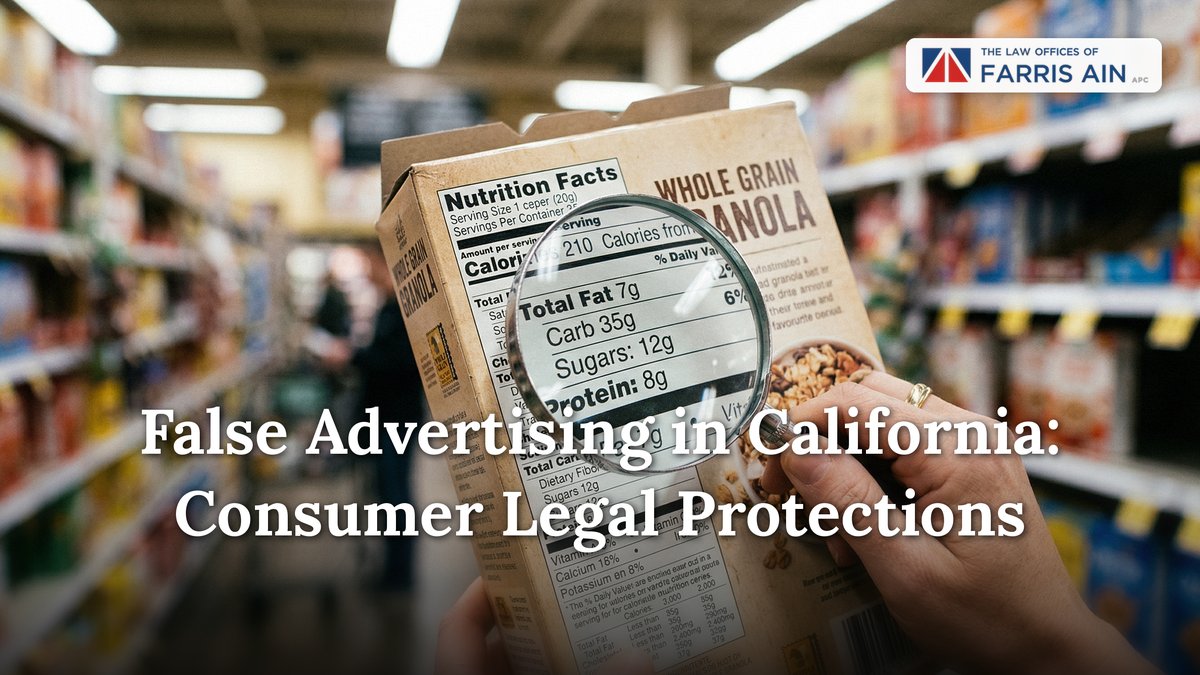
California has some of the strongest consumer protection laws in the country, and its false advertising statutes are a major reason why. If a business has deceived you through misleading marketing, hidden fees, fake reviews, deceptive labeling, or outright lies about a product or service, California law provides multiple legal avenues to fight back. In many cases, you don't even need to prove the company intended to deceive you.
Understanding how California's false advertising protections work can help you recognize when your rights have been violated and what remedies are available.
California's Three Consumer Protection Statutes
Most states have one general consumer protection law. California has three separate but overlapping statutes that address false advertising and unfair business practices. Each one has different elements, different remedies, and different strategic advantages. A single deceptive practice can give rise to claims under all three at once, which is part of what makes California such a powerful jurisdiction for consumer rights.
The Unfair Competition Law (UCL), Business & Professions Code 17200
The UCL is the broadest of the three statutes. It prohibits any "unlawful, unfair, or fraudulent business act or practice" as well as "unfair, deceptive, untrue, or misleading advertising." The UCL is uniquely powerful because of its three independent prongs:
- Unlawful prong: This is the UCL's most distinctive feature. It "borrows" violations of any other law (federal, state, or local) and treats them as independently actionable unfair competition. If a company violates an FDA regulation, an FTC rule, or even a local ordinance, consumers can sue under the UCL without needing a separate private right of action under the violated law.
- Unfair prong: Prohibits business practices that are unfair even if they don't technically violate any specific statute. Courts evaluate whether the practice is "immoral, unethical, oppressive, unscrupulous, or substantially injurious to consumers."
- Fraudulent prong: Targets conduct that is "likely to deceive" members of the public. You don't need to prove the business actually intended to deceive. You only need to show that the practice is likely to mislead a reasonable consumer.
The UCL provides restitution (getting your money back) and injunctive relief (court orders requiring the company to stop), but it does not provide damages or penalties. It can be brought by individual consumers, the Attorney General, district attorneys, and certain city attorneys.
The False Advertising Law (FAL), Business & Professions Code 17500
The FAL targets advertising that is "untrue or misleading" and that the advertiser knew or should have known was untrue or misleading. While narrower than the UCL, the FAL is important because it focuses on advertising content and applies a "reasonable consumer" standard. The ad must be evaluated from the perspective of how a typical consumer would understand it, not how a lawyer parsing the fine print might interpret it.
Like the UCL, the FAL provides restitution and injunctive relief. It can be used alongside UCL claims to strengthen a case involving deceptive advertising.
The Consumer Legal Remedies Act (CLRA), Civil Code 1750
The CLRA is in many ways the most powerful of the three statutes because it provides actual damages, punitive damages, and attorney's fees, which are remedies not available under the UCL or FAL. The CLRA lists 27 specific prohibited practices, including misrepresenting the characteristics of goods or services, advertising goods with intent not to sell them as advertised, and making false statements about the reasons for a price.
One important procedural requirement: before filing a CLRA lawsuit seeking damages, the consumer must send the business a written demand letter giving them 30 days to correct the violation. If the business adequately addresses the problem within that window, damages may be limited. But if the business ignores the demand or offers an inadequate remedy, the consumer can proceed to court seeking full damages plus attorney's fees.
The "Reasonable Consumer" Standard
California false advertising claims are evaluated under the reasonable consumer test. This asks whether members of the public are likely to be deceived. Not whether every possible consumer would be fooled, but whether a significant portion of the general consuming public, acting reasonably under the circumstances, would be misled.
This standard is intentionally consumer-friendly. Courts recognize that people don't scrutinize every word of an advertisement, don't read fine print, and don't approach marketing claims with the skepticism of a trained lawyer. If the overall impression conveyed by an ad is misleading, even if buried disclaimers technically correct the misrepresentation, the ad can still be unlawful.
Common Types of False Advertising
False advertising takes many forms. Some of the most common types of deceptive marketing practices we see in California include:
- Greenwashing. Companies falsely claiming products are "eco-friendly," "sustainable," "organic," or "all-natural" when they aren't, or when the claims are misleadingly vague. The FTC's Green Guides provide standards for environmental marketing claims, and California has been at the forefront of enforcing them.
- Subscription traps. Services that make it easy to sign up but deliberately difficult to cancel, use confusing terms to auto-renew subscriptions, or bury cancellation procedures. California's Automatic Renewal Law (ARL) targets these practices.
- "Made in USA" fraud. Products labeled as made in America when they are manufactured overseas or contain predominantly foreign components. The FTC and California's "Made in USA" statute both regulate these claims.
- Bait-and-switch pricing, where a product is advertised at an attractive price to lure customers, then the seller pushes them toward a more expensive alternative.
- Fake reviews and endorsements, including fabricated reviews, paid undisclosed endorsements, or suppression of negative reviews to create a misleading impression of product quality.
- Misleading health claims. Products marketed with unsubstantiated health benefits like "clinically proven," "doctor recommended," or "FDA approved" when they aren't.
- Hidden fees that conceal mandatory charges behind an advertised base price, substantially increasing the total cost. This is particularly common in travel, events, and subscription services.
Remedies Available to California Consumers
The remedies available depend on which statute you bring your claim under:
- Restitution (UCL, FAL, CLRA): the return of money you paid based on the deceptive practice
- Actual damages (CLRA): compensation for harm suffered, which can exceed the purchase price
- Statutory damages (CLRA): in a class action, the total damages award must be at least $1,000 (Civil Code 1780(a)(1))
- Punitive damages (CLRA): additional penalties for particularly egregious conduct
- Injunctive relief (UCL, FAL, CLRA): court orders requiring the business to stop the deceptive practice
- Attorney's fees (CLRA): the losing business pays the consumer's legal costs, making it economically feasible to bring claims even for modest amounts
Class Actions for Widespread False Advertising
Many false advertising cases affect large numbers of consumers in the same way. Everyone bought the same mislabeled product, subscribed to the same deceptive service, or relied on the same misleading claims. In these situations, a class action lawsuit may be the most effective vehicle for holding the company accountable and securing recovery for all affected consumers.
California's consumer protection statutes are particularly well-suited to class treatment because many of them don't require proof of individualized reliance. Under the UCL's fraudulent prong, for example, you need to show that the advertising was likely to deceive a reasonable consumer, not that each individual plaintiff personally relied on the specific misrepresentation. This makes class certification significantly easier than in jurisdictions that require each class member to prove individual reliance.
How to Pursue a False Advertising Claim
If you believe a company has deceived you through false advertising, there are several steps you should take:
- Preserve evidence. Save the advertisement, screenshot the website, keep the product packaging, retain receipts, and document any written claims that influenced your purchase.
- Send a CLRA demand letter. If you intend to seek damages under the Consumer Legal Remedies Act, the 30-day demand letter is a prerequisite. An attorney can draft this to maximize its effectiveness.
- File complaints. Report the deceptive practice to the FTC, the California Attorney General's Consumer Protection Division, and your local district attorney's office. These complaints create a paper trail and may trigger government enforcement.
- Consult an attorney. Consumer protection claims, especially those involving the interaction between the UCL, FAL, and CLRA, are legally complex. An experienced consumer rights attorney can evaluate which statutes apply, what remedies are available, and whether a related claim (such as a product defect or warranty claim) might also apply.
Don't Let Deceptive Companies Get Away With It
California's consumer protection laws exist because the legislature recognized that individual consumers are often outmatched by corporate resources. The UCL, FAL, and CLRA level the playing field, but only if consumers exercise their rights. At The Law Offices of Farris Ain, we fight for consumers throughout Southern California who have been harmed by deceptive business practices, false advertising, and corporate fraud.
If you believe you've been the victim of false or misleading advertising, contact us for a free consultation. Call (888) 525-5989 to discuss your situation and learn about your legal options.

The Law Offices of Farris Ain, APC
Attorney at The Law Offices of Farris Ain, APC. Dedicated to fighting for the rights of employees, consumers, and injury victims throughout Southern California.
Learn more about The Law Offices of Farris Ain, APC