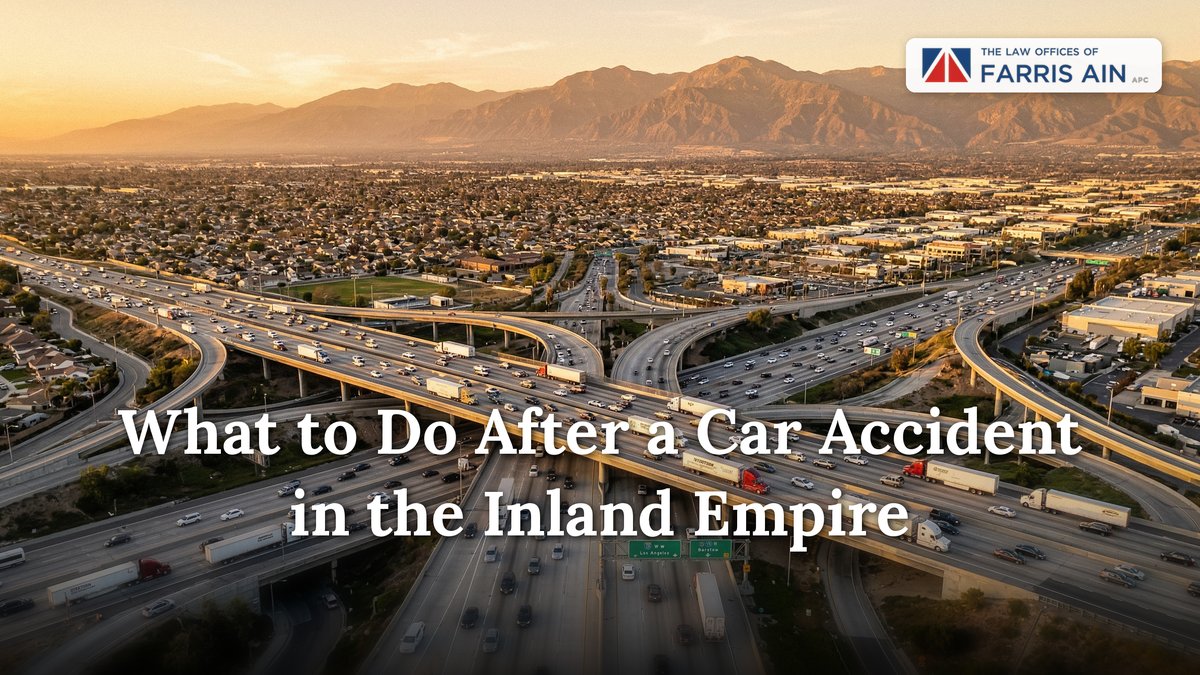
If you have been in a car accident in the Inland Empire, the decisions you make in the hours and days afterward can dramatically affect your ability to recover compensation. The Inland Empire, stretching across San Bernardino and Riverside Counties, sees some of the highest traffic collision rates in Southern California. Knowing exactly what to do after a crash is the best way to protect both your health and your legal rights.
It does not matter if your accident happened on the I-10 through Ontario, the I-15 near Rancho Cucamonga, the 210 Freeway in Claremont, or a surface street in Fontana. The steps below apply. Follow them carefully, and you will be in a far stronger position if you need to pursue an injury claim later.
Immediate Steps at the Scene of a Car Accident
The first few minutes after a collision are chaotic. Adrenaline is surging, and it can be difficult to think clearly. Here is what to prioritize:
1. Stop and Check for Injuries
California law requires you to stop at the scene of any accident involving injury or property damage. Check yourself and your passengers for injuries first. If anyone is seriously hurt, call 911 immediately. Do not attempt to move anyone with potential neck or spinal injuries unless there is an immediate danger such as fire.
2. Move to Safety If Possible
If the vehicles are drivable and blocking traffic, California Vehicle Code Section 20002 requires you to stop at the nearest location that will not impede traffic. On Inland Empire freeways, especially high-speed corridors like the I-10 and I-15, staying in an active traffic lane is extremely dangerous. Secondary collisions are a real threat, particularly with the heavy freight truck traffic on these highways.
3. Call the Police
Always call law enforcement after an accident involving injuries, and strongly consider it even for property-damage-only collisions. A police report creates an official record of the accident, including the officer's observations about fault, road conditions, and statements from both drivers. In disputed liability cases, this report can be invaluable evidence.
In unincorporated areas of San Bernardino or Riverside County, the California Highway Patrol (CHP) responds to freeway collisions. Within city limits, the local police department handles the report.
4. Document Everything at the Scene
Your phone is your best evidence-gathering tool. Use it to capture:
- Photos of all vehicles from multiple angles, showing the damage, license plates, and relative positions
- Photos of the scene including traffic signals, road conditions, skid marks, debris, weather conditions
- Photos of your injuries such as bruises, cuts, swelling, anything visible
- The other driver's information including name, insurance company, policy number, driver's license number, phone number
- Witness contact information with names and phone numbers of anyone who saw what happened
Do not rely on memory. Accident details fade quickly, and what feels unforgettable in the moment can become hazy within days.
5. Do Not Admit Fault
Be polite and cooperative, but do not apologize or say "it was my fault." Even casual statements like "I didn't see you" can be used against you later by the other driver's insurance company. Stick to the facts when speaking with police, and let the investigation determine fault.
Get Medical Attention, Even If You Feel Fine
This is the single most important piece of advice in this article: see a doctor within 24-48 hours of your accident, even if you do not think you are seriously hurt.
Many common car accident injuries, including whiplash, concussions, herniated discs, and internal bleeding, do not produce obvious symptoms immediately. Adrenaline masks pain, and soft tissue injuries often take days to fully manifest. Delayed-onset injuries are one of the leading reasons accident victims underestimate the severity of their conditions.
From a legal standpoint, a gap between your accident and your first medical visit gives the insurance company ammunition to argue that your injuries were not caused by the crash, or that they are not as serious as you claim. Prompt medical documentation connects your injuries directly to the collision.
Why the Inland Empire Is Especially Dangerous for Drivers
The Inland Empire has unique traffic safety challenges that contribute to its elevated accident rates. Understanding these risks is important context for any accident claim in the region:
- Heavy freight corridor: The I-10 and I-15 are primary routes connecting the ports of Los Angeles and Long Beach to warehouses and distribution centers throughout San Bernardino and Riverside Counties. That means a constant stream of semi-trucks, and collisions involving commercial vehicles tend to produce far more severe injuries.
- Rapid population growth: The Inland Empire has been one of the fastest-growing regions in California for two decades, but road infrastructure has not kept pace. Severe congestion on roads not designed for current traffic volumes is the result.
- Construction zones: Highway widening and improvement projects, including ongoing work on the I-10 and 15 interchange, create lane shifts, narrowed shoulders, and confusing signage that increase accident risk.
- Extreme heat: Summer temperatures regularly exceed 100 degrees, which can cause tire blowouts, overheated engines, and driver fatigue. All of these contribute to accidents.
- High-speed commuter corridors: Many Inland Empire residents commute long distances to jobs in LA or Orange County. Drowsy driving on the 210 Freeway or the 60 Freeway at the end of a long shift is a persistent hazard.
These regional factors can be relevant to your claim. An experienced vehicle accident attorney familiar with the Inland Empire understands how to incorporate local conditions into building your case.
Dealing with Insurance Companies After the Accident
Within days of your accident, you will likely receive a call from the at-fault driver's insurance adjuster. Approach this interaction carefully:
- You are not required to give a recorded statement to the other driver's insurance company. Politely decline until you have spoken with an attorney.
- Do not accept an early settlement offer. Insurance companies make fast, low offers precisely because they know the full extent of your injuries may not yet be clear. Once you sign a release, you cannot go back and ask for more, even if your condition worsens significantly.
- Report the accident to your own insurer as required by your policy, but keep your description factual and brief.
California is an at-fault state, meaning the driver who caused the accident (or their insurer) is responsible for the victim's damages. California also follows a pure comparative negligence rule. If you were partially at fault, your recovery is reduced by your percentage of fault, but you can still recover. Even if you were 50% or more at fault, you retain the right to compensation for the other driver's share of responsibility.
What Damages Can You Recover?
If another driver's negligence caused your accident, you could be entitled to compensation for:
- Medical expenses including emergency care, hospitalization, surgery, physical therapy, prescription medications, and future medical treatment
- Lost income covering wages lost during recovery, plus reduced earning capacity if your injuries are permanent
- Property damage for vehicle repair or replacement costs
- Pain and suffering covering physical pain, emotional distress, and loss of enjoyment of life. Learn more about how pain and suffering damages are calculated in California.
- Loss of consortium for the impact on your relationship with your spouse or family
Be aware that California imposes a statute of limitations on personal injury claims, generally two years from the date of the accident. Missing this deadline can permanently bar your claim.
When Should You Hire a Car Accident Attorney?
Not every fender-bender requires a lawyer. But you should strongly consider legal representation if:
- You suffered any injury requiring medical treatment beyond a single ER visit
- The other driver is disputing fault
- A commercial vehicle (truck, bus, rideshare) was involved
- The insurance company is offering a quick, low settlement
- Your injuries may require ongoing treatment or have affected your ability to work
- Multiple vehicles or parties were involved
Personal injury attorneys in California typically work on a contingency fee basis, meaning you pay nothing upfront and the attorney's fee comes out of the settlement or verdict. This removes the financial barrier to getting experienced legal help.
Protect Your Claim Starting Today
The aftermath of a car accident is stressful and overwhelming. But the actions you take now (documenting the scene, getting medical attention, preserving evidence, and being cautious with insurance adjusters) lay the foundation for a successful recovery.
At The Law Offices of Farris Ain, we represent accident victims throughout the Inland Empire, including Claremont, Ontario, Rancho Cucamonga, Pomona, Upland, and surrounding communities. We know these roads, we know the local courts, and we know how to hold negligent drivers and their insurers accountable.
Request a free consultation to discuss your accident. There is no obligation and no fee unless we win your case.

The Law Offices of Farris Ain, APC
Attorney at The Law Offices of Farris Ain, APC. Dedicated to fighting for the rights of employees, consumers, and injury victims throughout Southern California.
Learn more about The Law Offices of Farris Ain, APC