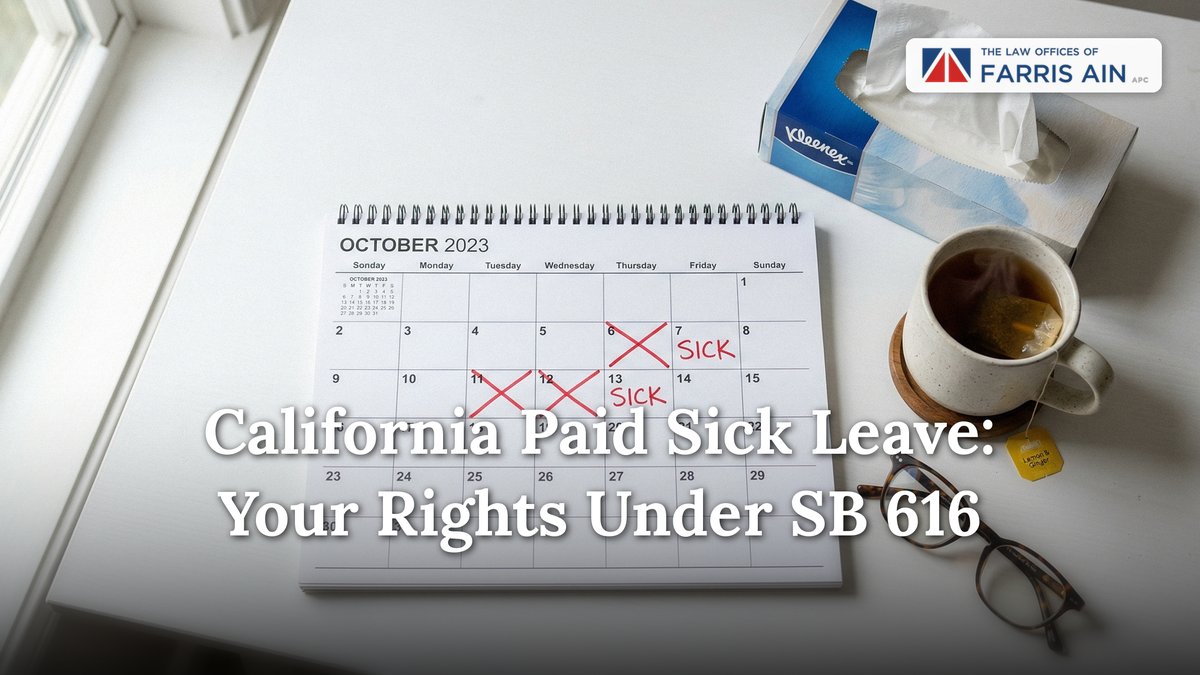
California has long been at the forefront of worker protection, and paid sick leave is a cornerstone of that commitment. In 2024, Senate Bill 616 significantly expanded the state's paid sick leave requirements, increasing the minimum from three days to five days per year. But while the headlines focused on that number, the details of how SB 616 actually works, and the ways some employers have quietly limited its real-world impact, deserve closer attention. If you work in California, understanding your paid sick leave rights under the new law is the only way to make sure you actually receive the time off you are entitled to.
At The Law Offices of Farris Ain, we help employees across Southern California enforce their workplace rights, including sick leave protections. Here is what you need to know about the current state of the law.
What SB 616 Changed About California Paid Sick Leave
Before SB 616 took effect on January 1, 2024, California's Healthy Workplaces, Healthy Families Act (Labor Code Section 245 et seq.) required employers to provide at least three days (24 hours) of paid sick leave per year. SB 616 raised that minimum to five days (40 hours), reflecting the reality that three days was simply not enough for workers dealing with serious illness, caregiving responsibilities, or recovery from medical procedures.
The full text of SB 616 amends several sections of the Labor Code to implement this expansion. The law applies to virtually all California employees, including part-time and temporary workers, who have worked for an employer for at least 30 days within a year.
Who Qualifies for Paid Sick Leave?
Nearly every worker in California qualifies. Under Labor Code Section 246, you are eligible for paid sick leave if you work in California for the same employer for 30 or more days within a year from the start of employment. This includes full-time employees, part-time employees, temporary employees, and seasonal workers. The only significant exemptions are for certain construction industry workers covered by qualifying collective bargaining agreements and employees of air carriers covered by the Railway Labor Act.
How Sick Leave Accrues: The Accrual Trap
This is where the law gets complicated, and where many employers exploit its flexibility to limit what employees actually receive. SB 616 allows employers to provide sick leave through two methods: accrual or frontloading.
Frontloading is simple. The employer provides the full five days (40 hours) of sick leave at the beginning of each benefit year. It is available immediately, no waiting required.
Accrual is where problems arise. Under the accrual method, employees earn one hour of paid sick leave for every 30 hours worked, though they cannot actually use accrued sick leave until the 90th day of employment. This sounds reasonable, but employers are permitted to set an accrual cap of 80 hours (10 days) and a separate annual use cap of 40 hours (five days). The interaction of these two caps, combined with carryover rules, creates a system that is technically compliant but confusing enough that employees never use their full entitlement.
Here is the specific trap we see regularly: an employer uses the accrual method and sets the cap at 80 hours. An employee accrues sick time throughout the year and carries over unused hours into the next year, accumulating a balance that appears generous. But the employer also imposes the annual use cap of 40 hours. So even though the employee's balance shows 60 or 70 hours, they can only actually use 40 hours in any given year. The remaining balance sits there, creating the illusion of ample sick leave while the employee's actual usable time is limited.
Making matters worse, some employers combine sick leave with PTO (paid time off) policies, rolling everything into a single bank. While this is technically permissible as long as the PTO policy meets or exceeds the minimums, it obscures the sick leave entitlement. Employees who use PTO for vacation may find that they have little or nothing left for illness, and may not realize that the law guarantees them a separate minimum of sick time that cannot be conditioned on advance notice or supervisor approval in the same way vacation might be.
What You Can Use Paid Sick Leave For
California's paid sick leave law covers a broad range of situations beyond personal illness. Under the DIR's guidance on paid sick leave, you can use your accrued sick leave for your own diagnosis, care, treatment, or preventive care, the diagnosis, care, or treatment of a family member (broadly defined to include spouse, registered domestic partner, child, parent, grandparent, grandchild, or sibling), and purposes related to being a victim of domestic violence, sexual assault, or stalking. Employees may also use accrued sick leave during bereavement leave granted under AB 1949 (effective 2023), though bereavement leave is a separate entitlement under FEHA, not a listed purpose under the paid sick leave statute itself.
The definition of "family member" under the sick leave law is broader than many employees realize. It includes biological, adopted, and foster children, as well as stepchildren, legal wards, and even designated persons (a person identified by the employee at the time the request is made). This expanded definition means you can take sick leave to care for a broader range of loved ones than you might expect.
Your Rights When Using Sick Leave
California law provides several important protections for employees who use their paid sick leave.
No retaliation. Your employer cannot fire, demote, suspend, or discipline you for using accrued sick leave. Labor Code Section 246.5 explicitly prohibits retaliation for exercising sick leave rights. If your employer takes adverse action against you after you use sick leave, you may have a retaliation claim. See our detailed guide on recognizing employer retaliation for more.
Minimal notice requirements. When the need for sick leave is foreseeable (a scheduled doctor's appointment, for example), you should provide reasonable advance notice. When the need is unforeseeable (sudden illness or a family emergency), you need only provide notice as soon as practicable. Your employer cannot require you to find a replacement worker as a condition of using sick leave.
No doctor's note for the minimum. While employers may require documentation for extended absences under separate leave laws, the paid sick leave statute does not require employees to provide a doctor's note to use their basic accrued sick time. Employers who condition the use of accrued sick leave on medical documentation may be violating the law.
Payment at regular rate. Paid sick leave must be paid at your regular rate of pay. This is typically your normal hourly rate or, for salaried employees, your effective hourly equivalent.
What to Do If Your Employer Violates Sick Leave Laws
If your employer is denying your sick leave, retaliating against you for using it, or using accrual caps and confusing PTO policies to effectively limit your legally guaranteed time off, you have options.
File a complaint with the Labor Commissioner. The California Division of Labor Standards Enforcement (DLSE) handles sick leave complaints. You can file online or at any DLSE office.
Consult with an employment attorney. Sick leave violations often occur alongside other wage and hour violations, such as failure to pay overtime, missed meal and rest breaks, or inaccurate pay stubs. An attorney can evaluate whether your employer's practices violate multiple provisions of the Labor Code, which can significantly increase the value and strength of your claim. Many sick leave cases connect to broader patterns of wage theft. See our guide on recovering unpaid wages in California for more context.
Know your deadlines. Claims for sick leave violations generally must be filed within three years under the Labor Code. Filing promptly, though, preserves evidence and demonstrates seriousness.
Make Sure You Get What the Law Guarantees
SB 616 was a meaningful step forward for California workers. But a law is only as good as its enforcement. If your employer is using confusing policies to limit your sick leave, retaliating against you for using it, or simply denying you the time off you have accrued, the employment law team at The Law Offices of Farris Ain can help.
Request a free consultation to discuss your situation. We serve workers throughout Los Angeles County, Orange County, and the Inland Empire, and we are committed to making sure California's worker protection laws work for the people they were designed to protect.

The Law Offices of Farris Ain, APC
Attorney at The Law Offices of Farris Ain, APC. Dedicated to fighting for the rights of employees, consumers, and injury victims throughout Southern California.
Learn more about The Law Offices of Farris Ain, APC