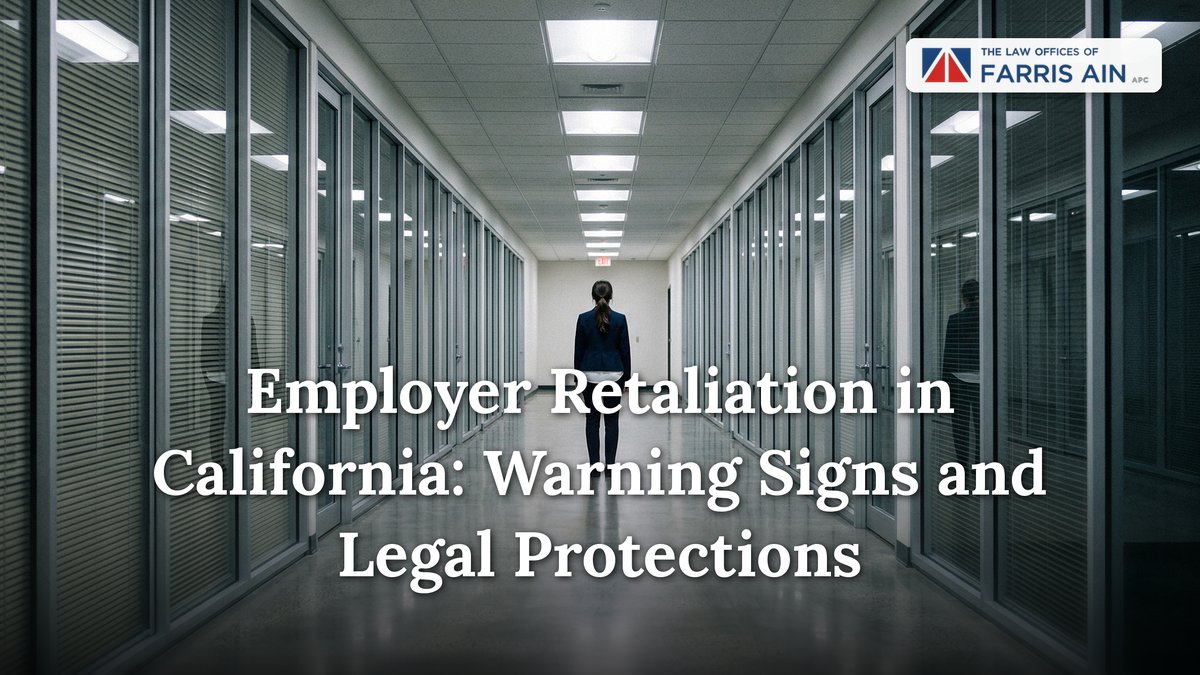
You did the right thing. You reported harassment. You filed a wage complaint. You took medical leave you were legally entitled to. And then everything at work changed. Your schedule shifted. Your projects disappeared. Your performance reviews, once solid, suddenly turned negative. If this pattern sounds familiar, you may be experiencing employer retaliation. Under California law, it is illegal.
Employer retaliation is one of the most common employment law violations in California, and one of the most underrecognized. Employees often sense that something has shifted at work after they engaged in a protected activity, but they may not realize that the shift itself is a separate and independently actionable legal claim. At The Law Offices of Farris Ain, we help employees across Southern California identify retaliation, document it effectively, and hold employers accountable.
What Counts as Employer Retaliation Under California Law?
Retaliation occurs when an employer takes an adverse action against an employee because the employee engaged in a legally protected activity. Three elements must be present for a retaliation claim:
- Protected activity: The employee did something the law protects.
- Adverse action: The employer took a materially negative action against the employee.
- Causal connection: The adverse action was motivated by the protected activity.
Each of these elements has specific legal meaning, and understanding them is key to recognizing retaliation when it happens to you.
Protected Activities Under California Law
California protects an exceptionally broad range of employee activities from retaliation. Under various provisions of the Labor Code, FEHA, and other statutes, the following are all protected:
- Filing a complaint about workplace discrimination or harassment (internally or with the Civil Rights Department)
- Reporting workplace safety violations to Cal/OSHA
- Filing a wage claim or reporting wage and hour violations
- Whistleblowing, which is reporting any activity you reasonably believe violates a law, rule, or regulation (Labor Code Section 1102.5)
- Taking protected leave, including FMLA, CFRA, pregnancy disability leave, or sick leave
- Filing a workers' compensation claim
- Refusing to participate in illegal activity
- Testifying or participating in a coworker's legal proceeding
- Discussing wages with coworkers
- Requesting reasonable accommodations for a disability
The breadth of these protections is significant. An employee who simply asks a question about whether their employer's pay practices comply with the law may be engaging in a protected activity. You do not need to file a formal complaint or hire a lawyer to trigger protection. Raising a concern, even informally, can be enough.
Warning Signs of Employer Retaliation
Retaliation is rarely announced. No manager says, "I'm reducing your hours because you filed that harassment complaint." Instead, retaliation tends to show up as a pattern of changes that begin shortly after the protected activity. Learning to recognize these patterns is important.
Sudden negative performance reviews. You had satisfactory or positive reviews for years. After you complained about discrimination or took FMLA leave, your next review is suddenly critical. This abrupt shift, particularly when your actual work quality hasn't changed, is one of the most common indicators of retaliation.
Exclusion from meetings, projects, or opportunities. You were previously included in team meetings, given meaningful assignments, or considered for promotions. After your protected activity, you are sidelined. Your emails go unanswered. You are left off meeting invites. Colleagues stop collaborating with you.
Schedule changes or reassignment. Your hours are cut, your shift is changed to a less desirable time, or you are transferred to a different location or department without a legitimate business reason.
Increased scrutiny and micromanagement. Your work is suddenly subjected to a level of scrutiny that your peers do not face. Every minor error is documented. You are required to provide detailed justifications for routine decisions that were previously within your discretion.
Hostile treatment from supervisors or coworkers. After your complaint, your manager becomes cold, dismissive, or openly hostile. Coworkers who were previously friendly begin avoiding you. You are treated as a troublemaker or someone who "can't be trusted."
Discipline for conduct that was previously tolerated. Every workplace has informal norms. If behavior that was always accepted (taking a slightly longer lunch, using your phone during downtime) suddenly becomes the basis for formal discipline only after you engaged in a protected activity, that inconsistency is a strong indicator of retaliatory motive.
Termination with shifting or pretextual reasons. This is often the clearest warning sign. If your employer fires you and the stated reason doesn't hold up, or if the reason changes each time you ask, or if other employees do the same thing without consequence, you may be looking at a wrongful termination driven by retaliatory intent.
Why Retaliation Claims Are Often Stronger Than the Underlying Claim
Here is the insight that changes the calculation for many of our clients: a retaliation claim can succeed even when the underlying complaint does not. This is one of the most important and most misunderstood aspects of employment law.
Consider this scenario. An employee believes they were passed over for a promotion because of their age and files an internal complaint. After investigation, it turns out the promotion decision was based on legitimate qualifications, and the age discrimination claim is weak. But after filing the complaint, the employee's manager begins excluding them from meetings, gives them a negative performance review for the first time in ten years, and fires them.
In that scenario, the age discrimination claim may not succeed. But the retaliation claim, based on the employer's response to the complaint, stands on its own. Courts and juries understand that punishing an employee for raising a good-faith concern is wrong, regardless of whether the underlying concern turns out to be legally valid. The law protects the act of complaining, not just the merit of the complaint.
This principle is codified in California law. Under FEHA and Labor Code Section 1102.5, an employee who reports what they reasonably believe to be illegal activity is protected from retaliation, even if the reported activity turns out not to be illegal. The protection attaches to the reasonable, good-faith act of reporting. Many of the strongest and most successful employment cases we handle are won primarily on the retaliation theory.
Documenting Retaliation Effectively
If you suspect retaliation, documentation is your most powerful tool. The goal is to create a contemporaneous record that establishes the timeline, the contrast with your prior treatment, and the connection to your protected activity.
Keep a detailed log. After each incident, write down the date, time, location, what happened, who was involved, and who witnessed it. Do this the same day while details are fresh. Use a personal device or notebook, not your work computer or email, which your employer can access.
Save all communications. Preserve emails, text messages, Slack messages, and any other written communications that relate to your work performance, assignments, schedule, or treatment. Forward relevant work emails to a personal account (check your employer's policies first, but courts generally protect employees who preserve evidence of illegal conduct).
Gather comparator evidence. If you are being disciplined for conduct that your coworkers engage in without consequence, document the discrepancy. Note specific examples of similarly situated employees who are treated differently. This comparative evidence is powerful in demonstrating that the discipline is pretextual.
Preserve your positive performance history. Collect copies of prior positive performance reviews, commendations, awards, and any evidence of your satisfactory work history before the protected activity occurred. The contrast between your treatment before and after you engaged in a protected activity is often the strongest evidence of retaliatory intent.
Filing a Retaliation Claim in California
The process for filing a retaliation claim depends on the type of protected activity involved.
FEHA retaliation (for complaints about discrimination or harassment): File with the Civil Rights Department (CRD) within three years. You can request an immediate right-to-sue notice to proceed to court. You may also file with the EEOC for federal claims.
Labor Code retaliation (for wage complaints, whistleblowing, sick leave use): File a complaint with the California Division of Labor Standards Enforcement (DLSE), or file a civil lawsuit directly.
Workers' compensation retaliation: File under Labor Code Section 132a with the Workers' Compensation Appeals Board.
In any retaliation case, timing matters. The closer in time the adverse action is to the protected activity, the stronger the inference of retaliatory motive. Temporal proximity alone is not always sufficient, but a termination that occurs within days or weeks of a protected complaint creates a powerful circumstantial case.
Taking Action Against Retaliation
If you have been retaliated against for exercising your legal rights, California law provides strong remedies. Successful retaliation claims can result in reinstatement, back pay and lost benefits, compensatory damages for emotional distress, punitive damages, and attorney's fees. In whistleblower cases under Labor Code Section 1102.5, the employee can also recover a civil penalty.
The employment law team at The Law Offices of Farris Ain has extensive experience handling retaliation cases throughout Los Angeles County, Orange County, and the Inland Empire. We understand the patterns, we know how to build the evidentiary record, and we are prepared to fight for employees who did the right thing and paid the price for it.
If you are experiencing changes at work after engaging in a protected activity, or if you were terminated under circumstances that feel retaliatory, don't wait. The earlier you consult with an attorney, the more effectively we can preserve evidence and build your case. Request a free consultation today. Your courage in speaking up deserves legal protection, and we are here to provide it.

The Law Offices of Farris Ain, APC
Attorney at The Law Offices of Farris Ain, APC. Dedicated to fighting for the rights of employees, consumers, and injury victims throughout Southern California.
Learn more about The Law Offices of Farris Ain, APC