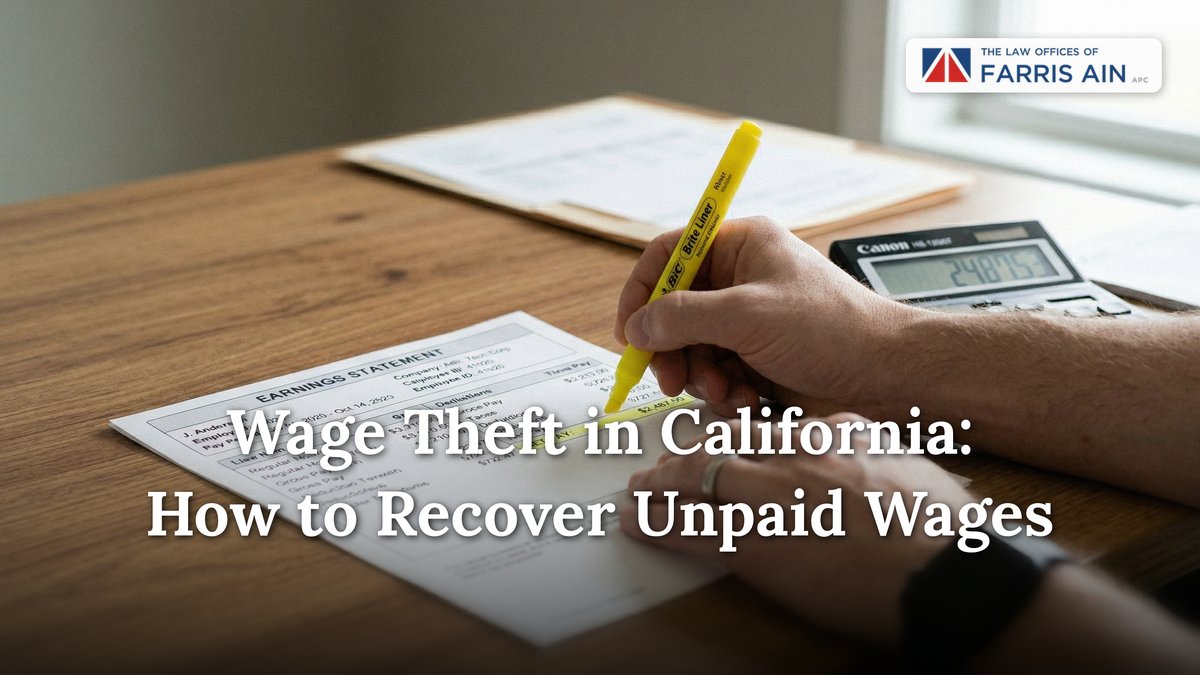
Every year, California workers lose billions of dollars to wage theft, the illegal practice of employers failing to pay workers what they are rightfully owed. From unpaid overtime and skipped meal breaks to deliberate misclassification schemes, wage theft remains one of the most widespread labor violations in the state. If you suspect your employer has been shortchanging your paycheck, understanding your rights under California employment law is the first step toward recovering what belongs to you.
California has some of the strongest worker protections in the nation. But those protections only matter if employees know they exist and know how to enforce them. Here is what you need to know about identifying wage theft, the legal tools available to fight it, and why acting quickly can make the difference between a full recovery and walking away empty-handed.
What Counts as Wage Theft in California?
Wage theft is not limited to an employer simply refusing to pay you. It takes many forms, and some are so normalized in certain industries that workers may not even realize their rights are being violated. Under California Labor Code Section 510 and related statutes, the most common forms of wage theft include:
- Unpaid overtime: California law requires time-and-a-half pay for hours worked beyond 8 in a day or 40 in a week, and double time for hours beyond 12 in a day. Many employers either fail to pay the correct rate or pressure workers to clock out before finishing their shifts.
- Meal and rest break violations: Under Labor Code Section 226.7, non-exempt employees are entitled to a 30-minute unpaid meal break for shifts over 5 hours and paid 10-minute rest breaks for every 4 hours worked. When employers deny, interrupt, or discourage these breaks, they owe one additional hour of pay at the employee's regular rate for each violation.
- Off-the-clock work: Requiring employees to perform tasks before clocking in or after clocking out is compensable time. That includes answering emails, setting up equipment, and attending mandatory meetings. No exceptions.
- Misclassification: Some employers deliberately classify workers as independent contractors or exempt salaried employees to avoid paying overtime, providing meal breaks, or covering workers' compensation insurance. Under California's ABC test (Labor Code Section 2775), a worker is presumed to be an employee unless the employer can prove otherwise.
- Tip theft: Employers who skim tips, require tip pooling with managers, or use tips to offset minimum wage obligations violate California law. Tips belong entirely to the employee.
- Failure to reimburse business expenses: Under Labor Code Section 2802, employers must reimburse employees for all necessary expenses incurred in performing their job duties, including mileage, cell phone use, and tools.
The Hidden Scale of Wage Theft
Many employees tolerate wage violations because the individual amounts seem small. A skipped lunch break here, 20 minutes of unpaid overtime there. But these amounts compound quickly. A worker shorted just 30 minutes per day earns roughly $3,000 less per year at a $20/hour wage, and that is before penalties and interest.
What most workers don't realize is that California law doesn't just allow you to recover the unpaid wages themselves. You could also recover:
- Waiting time penalties of up to 30 days of full wages if your employer fails to pay all owed wages upon termination
- Penalty wages of one hour of premium pay for each meal or rest break violation per day
- Interest on all unpaid amounts
- Attorneys' fees and costs, so that pursuing your claim doesn't cost you out of pocket
- Liquidated damages in minimum wage cases, an amount equal to the unpaid wages plus interest
PAGA: California's Most Powerful Tool Against Wage Theft
Here is something most employees never hear about: California's Private Attorney General Act (PAGA) gives individual workers the power to step into the shoes of the state and sue their employer on behalf of all affected employees, not just themselves.
This changes the game for wage theft cases. Suppose your employer has been denying meal breaks to you and 200 coworkers. Your individual claim might involve a few thousand dollars in unpaid premiums. A PAGA claim aggregates the violations across every affected employee, turning a modest individual case into a significant enforcement action with real civil penalties.
Under PAGA, the statutory penalty framework starts at $100 per employee per pay period for an initial violation and $200 for subsequent violations, but the 2024 PAGA reform (AB 2288/SB 92, effective June 19, 2024) significantly changed how penalties are calculated in practice. Courts can now reduce penalties to as low as $50 per pay period for isolated violations. The $200 subsequent-violation penalty applies primarily where a prior LWDA or court finding established that the employer's policy was unlawful, or where the employer acted with malice, fraud, or oppression. Employers who demonstrate they took all reasonable steps toward compliance can have penalties reduced to 15 to 30 percent of the statutory amount. For a company with hundreds of employees over a multi-year period, the aggregate exposure remains significant even under the reformed framework. Under the 2024 reform, 65% of PAGA penalties go to the state's Labor and Workforce Development Agency, and 35% goes to the affected employees.
The relationship between PAGA and arbitration has evolved through recent case law. In Viking River Cruises v. Moriana (2022), the U.S. Supreme Court held that individual PAGA claims can be compelled to arbitration under a valid arbitration agreement. However, the California Supreme Court's decision in Adolph v. Uber Technologies (2023) preserved employees' standing to pursue non-individual (representative) PAGA claims in court even when their individual claims have been sent to arbitration. In practice, this means employers can force your individual PAGA claim into arbitration, but you retain the right to pursue representative PAGA claims on behalf of other employees in court.
Filing a PAGA claim requires giving written notice to both your employer and the Labor and Workforce Development Agency (LWDA). If the agency does not investigate within 65 days, you gain the right to pursue the claim in court. Because PAGA cases are complex and carry strict procedural requirements, working with an experienced wage and hour attorney is strongly recommended.
How to Recover Unpaid Wages: Your Legal Options
California workers have several pathways to recover stolen wages, each with its own advantages:
1. File a Wage Claim with the Labor Commissioner
The California Division of Labor Standards Enforcement (DLSE), commonly known as the Labor Commissioner's Office, handles individual wage claims. You can file a claim online or at a local DLSE office. The process is free, and you do not need an attorney. After filing, the DLSE will schedule a settlement conference and, if no resolution is reached, a formal hearing before a deputy labor commissioner.
This route works well for simple claims involving clear-cut violations. The DLSE is often backlogged, though, and hearings can take months or longer to schedule. For complex cases or larger amounts, a private lawsuit is often more effective.
2. File a Private Lawsuit
You have the right to file a civil lawsuit against your employer for unpaid wages, penalties, interest, and attorneys' fees. Private lawsuits allow for more aggressive discovery, meaning your attorney can subpoena payroll records, timekeeping data, and internal communications that reveal the full scope of the violations.
Private lawsuits are particularly effective when multiple employees are affected, as they can be pursued as class actions. They are also the vehicle for PAGA claims, which must be filed in court.
3. Report to Government Agencies
In addition to filing a wage claim, you can report violations to the DLSE's Bureau of Field Enforcement, which conducts independent investigations of employers suspected of widespread violations. If your employer is also misclassifying workers, the Employment Development Department (EDD) and the IRS may be interested in the tax implications.
Protect Yourself from Retaliation
One of the biggest reasons employees hesitate to pursue wage theft claims is fear of retaliation. California law provides strong protections against this. Under Labor Code Section 98.6, it is illegal for an employer to terminate, demote, reduce hours, or otherwise punish any employee for filing a wage claim, complaining about labor law violations, or testifying in a proceeding.
If your employer retaliates against you for asserting your wage rights, you may have an additional retaliation claim that can result in significant additional damages, including reinstatement, back pay, and penalties.
Evidence That Strengthens Your Wage Theft Claim
Start gathering evidence as early as possible. The stronger your documentation, the harder it is for your employer to dispute your claim:
- Pay stubs: California employers are required to provide itemized wage statements. Keep every one.
- Personal time records: Keep your own log of hours worked, including start times, end times, and whether you received meal and rest breaks. A simple notes app on your phone works.
- Communications: Save emails, text messages, or memos from managers instructing you to work off the clock, skip breaks, or perform tasks outside your paid hours.
- Witness information: Coworkers experiencing the same violations can corroborate your claims.
- Employment documents: Your offer letter, employment agreement, employee handbook, and any arbitration agreement.
You should also be aware of your rights regarding paid sick leave, another area where employers frequently shortchange workers.
Time Limits for Wage Theft Claims
Do not wait too long. California imposes statutes of limitation on wage claims:
- 3 years for most unpaid wage claims (including overtime and minimum wage)
- 4 years for claims based on breach of a written employment contract
- 1 year for PAGA penalty claims (from the date of the most recent violation)
- 3 years for waiting time penalties and expense reimbursement claims
Every pay period that passes may mean lost recovery. The sooner you act, the more you can recover.
Take Action to Recover What You Are Owed
Wage theft is not a minor inconvenience. It is money taken from your pocket, your family's budget, and your financial future. California law provides powerful remedies, including PAGA penalties that can hold employers accountable not just to you but to every worker they have shortchanged.
At The Law Offices of Farris Ain, we represent employees throughout Southern California in wage and hour claims, including overtime violations, meal and rest break claims, misclassification cases, and PAGA actions. There is no fee unless we recover compensation for you.
Request a free consultation to discuss your situation. If your employer has been stealing your wages, you have every right to take them back.

The Law Offices of Farris Ain, APC
Attorney at The Law Offices of Farris Ain, APC. Dedicated to fighting for the rights of employees, consumers, and injury victims throughout Southern California.
Learn more about The Law Offices of Farris Ain, APC