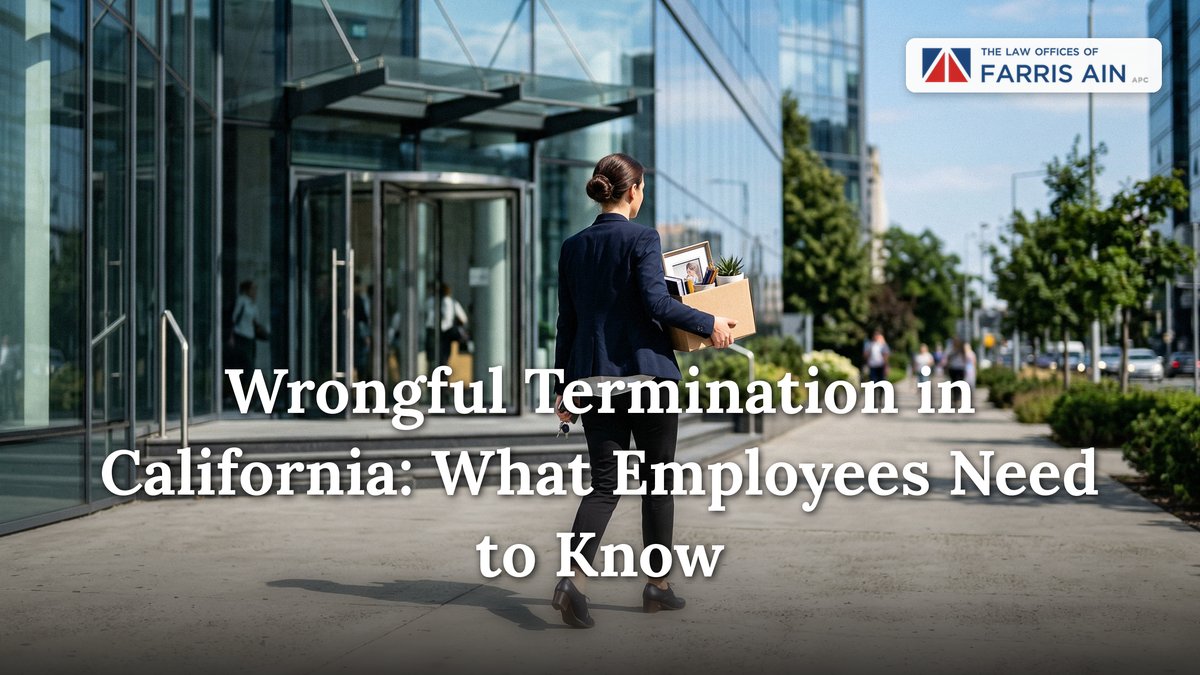
Losing your job is one of the most stressful experiences a person can go through. When it happens suddenly, or for reasons that feel deeply unfair, the emotional and financial toll can be overwhelming. But there is a hard truth that every California worker needs to understand: being fired unfairly and being fired illegally are not the same thing. Wrongful termination in California has a specific legal meaning, and knowing the difference can determine whether you have a viable claim or simply a bad experience.
At The Law Offices of Farris Ain, we regularly speak with employees who feel they were treated unjustly at work. Many are surprised to learn that California's at-will employment doctrine gives employers broad latitude to fire workers for almost any reason. But that latitude has real limits. When an employer crosses those legal lines, the termination becomes wrongful, and the employee may be entitled to significant compensation.
What Makes a Termination "Wrongful" Under California Law?
California is an at-will employment state. That means, as a general rule, employers can terminate employees at any time, for any reason, or for no reason at all. This is the baseline that surprises many workers. Your boss can fire you because they don't like your personality, because the company is restructuring, or even for reasons that seem petty or irrational.
At-will employment is not a blank check, though. California law carves out several important exceptions where a termination crosses the line from "unfair" to "illegal." These exceptions are the key to determining whether you have a wrongful termination claim.
Discrimination-Based Termination
Under the California Fair Employment and Housing Act (FEHA), it is illegal to fire someone because of their membership in a protected class. This includes race, color, national origin, ancestry, religion, sex, gender, gender identity, gender expression, sexual orientation, marital status, age (40+), disability, medical condition, genetic information, military or veteran status, and reproductive health decision-making. FEHA's list of protected classes is broader than federal law, which means California employees have more protections than workers in many other states.
If you were terminated and you believe your membership in any of these categories was a motivating factor, you may have a wrongful termination claim. The employer doesn't have to explicitly say, "I'm firing you because of your age." Evidence of discriminatory intent can be circumstantial. A pattern of younger employees being promoted while older workers are pushed out, for example, can speak volumes.
Retaliation for Protected Activities
California law protects employees who exercise their legal rights from employer retaliation. You cannot be fired for filing a workers' compensation claim, reporting workplace safety violations, complaining about unpaid wages, reporting illegal activity (whistleblowing), taking protected leave such as family medical leave or pregnancy disability leave, or participating in an investigation of workplace misconduct.
California Labor Code Section 1102.5 is one of the strongest whistleblower protection statutes in the country. If you reported what you reasonably believed to be a violation of law and your employer fired you in response, you may have a powerful retaliation claim. For more on how retaliation works, see our guide on warning signs of employer retaliation.
Violation of Public Policy
Even without a specific statute, California courts recognize wrongful termination claims when the firing violates a fundamental public policy. Classic examples include being fired for refusing to commit an illegal act (such as falsifying records), being fired for performing a legal obligation (like jury duty), or being fired for exercising a constitutional right.
The public policy exception is broader than many employees realize. Courts have recognized claims where employees were fired for refusing to sign non-compete agreements that violate California law, or for objecting to unsafe working conditions.
Breach of an Implied Contract
Even in an at-will state, employers can create implied contracts through their actions and communications. If your employer made verbal promises of continued employment, if the employee handbook describes specific termination procedures, or if a long history of employment with positive reviews creates an expectation of job security, a court may find that an implied contract existed and that breaking it constituted wrongful termination.
The Distinction Most Employees Miss
Here is the insight that changes the conversation for many of our clients: the question is never whether your termination was fair. The question is whether it was illegal. An employer can fire you for a reason that is arbitrary, inconsistent, or even demonstrably wrong, and it may still be perfectly legal. What matters is whether the real reason falls into one of the protected categories above.
This distinction matters enormously in practice. We frequently speak with employees who say, "My boss fired me because she doesn't like me." That alone is not wrongful termination. But if the reason the boss "doesn't like" the employee is rooted in the employee's race, disability, or the fact that the employee filed a wage complaint, then the calculus changes entirely.
The strongest wrongful termination cases are built on specific evidence tying the termination to a protected characteristic or protected activity, not on a general sense of injustice. Timing, comparator evidence (how similarly situated employees of different backgrounds were treated), and documented pretextual reasons are the building blocks of successful claims.
What to Do Immediately After a Wrongful Termination
If you believe you were wrongfully terminated, the steps you take in the first days and weeks can significantly affect the strength of your case.
Preserve all documentation. Save emails, text messages, performance reviews, and any written communications related to your employment and termination. If you received a termination letter, keep the original. If you were given a verbal reason for your firing, write it down immediately while the details are fresh.
Request your personnel file. Under California Labor Code Section 1198.5, you have the right to inspect your personnel file and obtain copies of any documents you signed. Your employer must comply within 30 days.
Do not sign a severance agreement without legal review. Employers often present severance packages that include broad releases of all legal claims. Once you sign, you may waive your right to pursue a wrongful termination case. An attorney can review the agreement to ensure you understand what you are giving up and whether the severance offer is reasonable given the strength of your potential claims.
File for unemployment benefits. This protects your financial situation and does not harm a future legal claim. In fact, if the employer contests your unemployment claim and provides a reason for your termination that differs from what they told you, that inconsistency can become useful evidence.
Be mindful of deadlines. Wrongful termination claims in California have strict time limits. For claims under FEHA, you generally must file a complaint with the Civil Rights Department (CRD) or the EEOC within three years. Other claims may have shorter deadlines. Waiting too long can permanently bar your claim, no matter how strong it is.
Remedies Available in Wrongful Termination Cases
If your wrongful termination claim succeeds, California law provides several potential remedies. These include back pay and lost benefits from the date of termination, front pay (future lost earnings if reinstatement is not practical), emotional distress damages, punitive damages in cases involving malice or oppression, and attorney's fees and costs in FEHA cases.
The value of a wrongful termination claim depends on many factors: the strength of the evidence, the employee's salary and tenure, the egregiousness of the employer's conduct, and the availability of other employment. An experienced employment law attorney can evaluate your specific circumstances and provide a realistic assessment of potential outcomes.
Why Early Legal Consultation Matters
Wrongful termination cases are fact-intensive. The difference between a strong claim and a weak one often comes down to evidence that exists in the first weeks after termination. Emails get deleted. Witnesses' memories fade. Employers revise their narrative. The sooner you consult with an attorney, the better positioned you are to preserve the evidence that matters.
At The Law Offices of Farris Ain, we offer free consultations to employees who believe they may have been wrongfully terminated. We can help you understand whether your situation falls within one of California's exceptions to at-will employment and what your options are going forward. If you have been fired and something feels wrong, request a free consultation today. Understanding your rights is the first step toward protecting them.

The Law Offices of Farris Ain, APC
Attorney at The Law Offices of Farris Ain, APC. Dedicated to fighting for the rights of employees, consumers, and injury victims throughout Southern California.
Learn more about The Law Offices of Farris Ain, APC